Invisible Behind Bars: How Anti-Blackness Shapes U.S. Immigration Detention and Erases Black Migrants from the DataInvisibles tras las rejas: cómo el racismo antinegro moldea la detención migratoria en EE. UU. y borra a los migrantes negros de los datos
ICE tracks nationality, not race, so Black migrants, especially Afro-Latinos, vanish from the official count. Even the undercounted numbers show harsher bonds, more abuse complaints and six times the rate of solitary confinement.ICE registra la nacionalidad, no la raza, y así los migrantes negros, en especial los afrolatinos, desaparecen del conteo oficial. Aun con cifras subestimadas, enfrentan fianzas más altas, más denuncias de abuso y seis veces más aislamiento solitario.
 ByPor Dr. Richard Nuñez-Lawrence, Founding Executive Director, ALAPADirector ejecutivo fundador de ALAPA6 min readmin de lectura
When public debates turn to United States immigration enforcement, the conversation almost always centers on the southern border through a monolithic lens. Yet inside the sprawling network of federal detention centers, private prisons, and county jails overseen by U.S. Immigration and Customs Enforcement (ICE), a distinct and severe crisis plays out along racial lines.
For Black migrants—whether they are Afro-Latinos from Cuba, the Dominican Republic, Colombia, and Honduras, or immigrants from Haiti, Jamaica, Nigeria, and Cameroon—the U.S. immigration system does not operate in a vacuum. Instead, it merges punitive border policies with the deeply entrenched anti-Blackness of the domestic criminal legal system.
Even more alarming, the true scale of how many Black people are locked inside immigration detention remains largely obscured. Because federal agencies fail to properly track race and ethnicity, thousands of Black detainees—especially Afro-Latinos—are systematically undercounted, rendering their disproportionate suffering invisible in official government records.
The Data Blind Spot: Why the Real Numbers Are Higher Than Reported
If you look for an official federal headcount of how many Black people are currently held in ICE custody, you will not find one. Unlike local police departments, state prisons, or the U.S. Census, the Department of Homeland Security (DHS) and ICE do not systematically collect or publicly release racial demographic data on the people they detain.
As investigations by the International Consortium of Investigative Journalists (ICIJ) and data analyses from Syracuse University’s Transactional Records Access Clearinghouse (TRAC) have documented, ICE tracks country of citizenship rather than race. Consequently, civil rights researchers and journalists are forced to rely on an imperfect workaround: using nationality as a proxy for race by counting individuals from predominantly Black nations in Africa and the Caribbean.
This statistical loophole creates a massive undercount for two critical reasons:
- The Erasure of Afro-Latinos: When an Afro-Cuban, Afro-Colombian, Garifuna, or Black Dominican migrant is detained by ICE, federal databases record only their Latin American nationality. In government spreadsheets and public policy analyses, their Blackness is completely erased. Because Latin America is home to over 130 million people of African descent—and Black Latinos frequently face heightened policing and targeted displacement in their home countries—counting only African and Caribbean nations leaves out a substantial portion of the Black detained population.
- Multi-Racial and Diaspora Blind Spots: Migrants of African descent arriving from European nations, South America, or diverse Caribbean territories like Belize and Trinidad and Tobago are similarly misclassified or omitted from nationality-based proxy counts.
As a result, when researchers and reporters cite that Black migrants make up roughly 4% to 6% of the official ICE detention population, those figures represent an absolute floor, not a ceiling. The true number of Black people behind detention bars is significantly higher.
Disproportionate Targeting: From Street Policing to Deportation
Even with conservative proxy estimates that undercount Afro-Latinos, the available data exposes glaring racial disparities at every stage of the enforcement pipeline.
- The Policing-to-Deportation Pipeline: Black immigrants are disproportionately swept into ICE custody through domestic racial profiling. According to research by the Black Alliance for Just Immigration (BAJI) and NYU School of Law, as highlighted in reporting by Capital B News, while Black people make up roughly 5.4% of the undocumented population in the U.S., they account for 20.3% of all immigrants facing deportation on criminal grounds before the Executive Office for Immigration Review. Furthermore, BAJI’s data reveals that 76% of deported Black immigrants had prior contact with the police or the criminal legal system—a direct consequence of over-policing in Black and Brown neighborhoods. Once convicted of an offense, Black immigrants face a 76% chance of deportation—and 83% for Caribbean immigrants—compared to 45% for the overall immigrant population.
- Higher Bonds and Longer Stays: Once detained, Black migrants face steeper financial barriers to freedom. According to bond data analyzed by the legal nonprofit RAICES, the average immigration bond set for Haitian migrants is $16,700—roughly 54% higher than the average bond required for other immigrant groups. Unable to pay inflated bonds, Black detainees languish in custody for months or even years longer than non-Black detainees.
- Asylum Denials: At the border and in immigration courts, Black asylum seekers encounter systemic skepticism. According to a submission to the United Nations by Human Rights First, Sub-Saharan African asylum seekers face negative credibility findings at rates 37% higher than average, while Haitian asylum seekers experienced an 82% denial rate over a two-decade span.
Extreme Abuse and Isolation Inside Detention Walls
Inside detention facilities—many of which are operated by for-profit prison corporations in the American South—anti-Black bias translates directly into physical violence, medical neglect, and psychological torture.
A joint investigation by Freedom for Immigrants, BAJI, the UndocuBlack Network, and the Black LGBTQIA+ Migrant Project—reported by the Los Angeles Times—analyzed nearly 17,000 calls made between 2016 and 2021 to the National Immigration Detention Hotline. Their findings uncovered staggering disparities:
- Disproportionate Abuse: According to the Los Angeles Times summary of the report, although people from predominantly Black countries accounted for just 6% of the tracked ICE detainee population, they filed 28% of all abuse-related complaints.
- Severe, Life-Threatening Cases: According to the American Immigration Council, 53% of the most severe, high-intensity human rights cases requiring urgent intervention involved Black migrants.
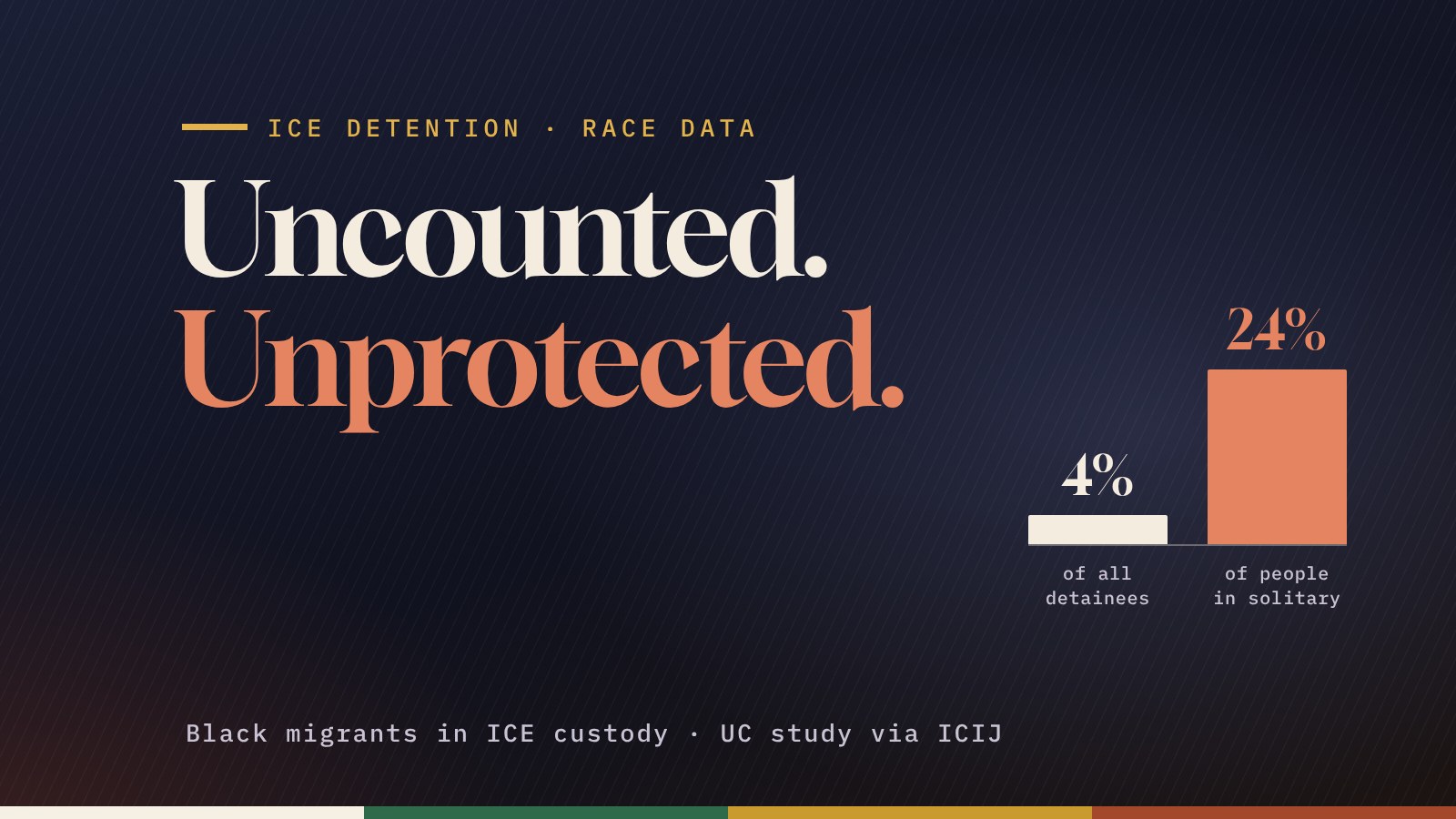
- Solitary Confinement as Punishment: A landmark study by University of California researchers, published in partnership with the International Consortium of Investigative Journalists (ICIJ) and cited by the ACLU of Maryland, found that ICE placed detained immigrants from majority-Black African and Caribbean countries in solitary confinement at six times the rate of the general detained population. Accounting for just 4% of tracked detainees during the study window, Black migrants made up 24% of everyone locked in solitary isolation.
- Compounded Vulnerability: According to Freedom for Immigrants, in detention facilities across Alabama, Georgia, and Louisiana, Black detainees are nearly twice as likely to experience abuse compared to non-Black peers, while Black non-binary and LGBTQ+ migrants face 3.5 times the risk of abuse while in custody.
For Afro-Latino detainees, this violence often carries an added layer of isolation. Placed in housing units segregated by language or nationality, Afro-Latinos frequently report facing anti-Black discrimination from guards and fellow detainees alike, while simultaneously being denied culturally competent translation services or advocacy networks that recognize their dual identity.
The Policy Mandate: Counting Everyone to Protect Everyone
The erasure of Blackness within ICE’s data systems is not merely a clerical oversight; it is a policy failure that shields systemic human rights abuses from federal accountability. When agencies refuse to record race alongside ethnicity and nationality, lawmakers cannot accurately measure racial disparities, civil rights attorneys struggle to prove patterns of discriminatory enforcement, and Afro-Latino migrants remain caught in a statistical blind spot.
According to policy blueprints issued by the American Immigration Council, BAJI, and Freedom for Immigrants, meaningful reform requires several immediate policy shifts:
- Mandatory Racial and Ethnic Disaggregation: Congress and the Department of Homeland Security must mandate the collection and public reporting of self-identified race and ethnicity data across all ICE arrests, detention facilities, bond hearings, and deportation proceedings—explicitly allowing migrants to identify as both Black and Hispanic/Latino.
- Ending Local Police Collaborations: Repealing programs like 287(g) that deputize local police to act as immigration agents, thereby severing the pipeline that turns racially profiled traffic stops in Black and Afro-Latino neighborhoods into deportation orders.
- Oversight and Abolition of For-Profit Detention: Establishing independent civil rights oversight with subpoena power over detention conditions while phasing out mandatory detention and private prison contracts that profit from the prolonged incarceration of Black migrants.
Until federal policy recognizes that Black immigrants come from across the entire globe—including the Spanish-speaking Americas—thousands of Black lives will remain uncounted, unprotected, and locked away behind detention walls.
Dr. Richard Nuñez-Lawrence is the founding Executive Director of the Afro-Latino Association for Policy and Advocacy (ALAPA).
Cuando el debate público se ocupa de la aplicación de las leyes migratorias en Estados Unidos, la conversación casi siempre se centra en la frontera sur y la mira con un lente monolítico. Sin embargo, dentro de la extensa red de centros de detención federales, prisiones privadas y cárceles de condado que supervisa el Servicio de Inmigración y Control de Aduanas (ICE), se desarrolla una crisis distinta y grave que sigue líneas raciales.
Para los migrantes negros —ya sean afrolatinos de Cuba, la República Dominicana, Colombia y Honduras, o inmigrantes de Haití, Jamaica, Nigeria y Camerún—, el sistema migratorio estadounidense no funciona en el vacío. Por el contrario, fusiona políticas fronterizas punitivas con el racismo antinegro profundamente arraigado en el sistema penal del país.
Más alarmante aún, la verdadera magnitud de cuántas personas negras están encerradas en centros de detención migratoria sigue en gran medida oculta. Como las agencias federales no registran adecuadamente la raza y la etnia, miles de detenidos negros —en especial afrolatinos— quedan sistemáticamente subcontados, y su sufrimiento desproporcionado se vuelve invisible en los registros oficiales del gobierno.
El punto ciego de los datos: por qué las cifras reales son más altas de lo que se informa
Si busca un conteo federal oficial de cuántas personas negras están hoy bajo custodia de ICE, no lo encontrará. A diferencia de los departamentos de policía locales, las prisiones estatales o el Censo de EE. UU., el Departamento de Seguridad Nacional (DHS) e ICE no recopilan de forma sistemática ni publican datos demográficos raciales sobre las personas que detienen.
Como han documentado investigaciones del Consorcio Internacional de Periodistas de Investigación (ICIJ) y análisis de datos del Transactional Records Access Clearinghouse (TRAC) de la Universidad de Syracuse, ICE registra el país de ciudadanía y no la raza. Por eso, investigadores de derechos civiles y periodistas se ven obligados a recurrir a una solución imperfecta: usar la nacionalidad como indicador de la raza y contar a las personas procedentes de países mayoritariamente negros de África y el Caribe.
Este vacío estadístico produce un subconteo enorme por dos razones fundamentales:
- La invisibilización de los afrolatinos: Cuando ICE detiene a un migrante afrocubano, afrocolombiano, garífuna o dominicano negro, las bases de datos federales registran solo su nacionalidad latinoamericana. En las hojas de cálculo del gobierno y en los análisis de políticas públicas, su negritud se borra por completo. Como América Latina alberga a más de 130 millones de personas de ascendencia africana —y los latinos negros a menudo sufren más vigilancia policial y desplazamientos dirigidos en sus países de origen—, contar solo a los países de África y el Caribe deja fuera a una parte sustancial de la población negra detenida.
- Puntos ciegos multirraciales y de la diáspora: Los migrantes de ascendencia africana que llegan desde países europeos, Sudamérica o territorios caribeños diversos como Belice y Trinidad y Tobago también quedan mal clasificados u omitidos en los conteos basados en la nacionalidad.
En consecuencia, cuando investigadores y periodistas citan que los migrantes negros representan entre el 4 % y el 6 % de la población oficial detenida por ICE, esas cifras son un piso absoluto, no un techo. El número real de personas negras tras las rejas de la detención migratoria es considerablemente mayor.
Persecución desproporcionada: de la vigilancia policial a la deportación
Incluso con estimaciones conservadoras que subcuentan a los afrolatinos, los datos disponibles revelan disparidades raciales flagrantes en cada etapa del proceso de control migratorio.
- De la vigilancia policial a la deportación: Los inmigrantes negros terminan bajo custodia de ICE en proporción desmedida a causa del perfilamiento racial dentro del país. Según investigaciones de la Black Alliance for Just Immigration (BAJI) y la Facultad de Derecho de la Universidad de Nueva York, destacadas en reportajes de Capital B News, aunque las personas negras constituyen aproximadamente el 5,4 % de la población indocumentada en EE. UU., representan el 20,3 % de todos los inmigrantes que enfrentan la deportación por causas penales ante la Oficina Ejecutiva de Revisión de Casos de Inmigración. Además, los datos de BAJI muestran que el 76 % de los inmigrantes negros deportados había tenido contacto previo con la policía o el sistema penal, consecuencia directa de la vigilancia policial excesiva en barrios negros y morenos. Una vez condenados por un delito, los inmigrantes negros enfrentan un 76 % de probabilidad de deportación —y los inmigrantes caribeños, un 83 %—, frente al 45 % del conjunto de la población inmigrante.
- Fianzas más altas y detenciones más largas: Una vez detenidos, los migrantes negros enfrentan barreras económicas más altas para recuperar la libertad. Según datos de fianzas analizados por la organización jurídica sin fines de lucro RAICES, la fianza migratoria promedio fijada para migrantes haitianos es de 16.700 dólares, alrededor de un 54 % más que la fianza promedio exigida a otros grupos de inmigrantes. Sin poder pagar fianzas infladas, los detenidos negros permanecen bajo custodia meses o incluso años más que los detenidos que no son negros.
- Denegaciones de asilo: En la frontera y en los tribunales de inmigración, los solicitantes de asilo negros se topan con un escepticismo sistémico. Según una presentación de Human Rights First ante las Naciones Unidas, los solicitantes de asilo de África subsahariana reciben dictámenes negativos de credibilidad con una frecuencia un 37 % mayor que el promedio, mientras que a los solicitantes haitianos se les negó el asilo en el 82 % de los casos durante un período de dos décadas.
Abuso extremo y aislamiento tras los muros de la detención
Dentro de los centros de detención —muchos de ellos operados por corporaciones penitenciarias con fines de lucro en el sur de Estados Unidos—, el sesgo antinegro se traduce directamente en violencia física, negligencia médica y tortura psicológica.
Una investigación conjunta de Freedom for Immigrants, BAJI, UndocuBlack Network y el Black LGBTQIA+ Migrant Project —reseñada por Los Angeles Times— analizó casi 17.000 llamadas realizadas entre 2016 y 2021 a la Línea Nacional de Detención Migratoria. Sus hallazgos revelaron disparidades asombrosas:
- Abuso desproporcionado: Según el resumen del informe publicado por Los Angeles Times, aunque las personas procedentes de países mayoritariamente negros representaban solo el 6 % de la población detenida por ICE en el estudio, presentaron el 28 % de todas las denuncias relacionadas con abusos.
- Casos graves que ponen en riesgo la vida: Según el American Immigration Council, el 53 % de los casos de derechos humanos más graves y de mayor intensidad, que requerían intervención urgente, involucraban a migrantes negros.
- El aislamiento solitario como castigo: Un estudio de referencia de investigadores de la Universidad de California, publicado en colaboración con el Consorcio Internacional de Periodistas de Investigación (ICIJ) y citado por la ACLU de Maryland, encontró que ICE colocó en aislamiento solitario a inmigrantes detenidos de países africanos y caribeños de mayoría negra seis veces más que al resto de la población detenida. Aunque eran solo el 4 % de los detenidos registrados durante el período del estudio, los migrantes negros representaron el 24 % de todas las personas encerradas en aislamiento.
- Vulnerabilidad acumulada: Según Freedom for Immigrants, en centros de detención de Alabama, Georgia y Luisiana, los detenidos negros tienen casi el doble de probabilidades de sufrir abusos que sus pares no negros, mientras que los migrantes negros no binarios y LGBTQ+ enfrentan 3,5 veces más riesgo de abuso bajo custodia.
Para los detenidos afrolatinos, esta violencia suele sumar una capa adicional de aislamiento. Ubicados en unidades separadas por idioma o nacionalidad, los afrolatinos denuncian con frecuencia discriminación antinegra tanto de los guardias como de otros detenidos, y al mismo tiempo se les niegan servicios de traducción culturalmente competentes o redes de apoyo que reconozcan su doble identidad.
El mandato de política pública: contar a todos para proteger a todos
La invisibilización de la negritud en los sistemas de datos de ICE no es un simple descuido administrativo; es una falla de política pública que protege los abusos sistemáticos de derechos humanos de la rendición de cuentas federal. Cuando las agencias se niegan a registrar la raza junto con la etnia y la nacionalidad, los legisladores no pueden medir con precisión las disparidades raciales, los abogados de derechos civiles tienen dificultades para demostrar patrones de aplicación discriminatoria y los migrantes afrolatinos siguen atrapados en un punto ciego estadístico.
Según las propuestas de política pública del American Immigration Council, BAJI y Freedom for Immigrants, una reforma significativa exige varios cambios inmediatos:
- Desagregación racial y étnica obligatoria: El Congreso y el Departamento de Seguridad Nacional deben exigir la recopilación y publicación de datos de raza y etnia autoidentificadas en todos los arrestos de ICE, centros de detención, audiencias de fianza y procesos de deportación, permitiendo de forma explícita que los migrantes se identifiquen a la vez como negros e hispanos o latinos.
- Fin de la colaboración de la policía local: Derogar programas como el 287(g), que facultan a la policía local para actuar como agentes de inmigración, y así romper el ciclo que convierte las paradas de tránsito por perfilamiento racial en barrios negros y afrolatinos en órdenes de deportación.
- Supervisión y abolición de la detención con fines de lucro: Establecer una supervisión independiente de derechos civiles, con facultad de citación, sobre las condiciones de detención, y eliminar gradualmente la detención obligatoria y los contratos con prisiones privadas que se lucran con el encarcelamiento prolongado de migrantes negros.
Mientras la política federal no reconozca que los inmigrantes negros provienen de todo el mundo —incluidas las Américas hispanohablantes—, miles de vidas negras seguirán sin contarse, sin protección y encerradas tras los muros de la detención.
El Dr. Richard Nuñez-Lawrence es el director ejecutivo fundador de la Asociación Afrolatina de Política y Defensa (Afro-Latino Association for Policy and Advocacy, ALAPA).
ALAPA, the Afro-Latino Association for Policy & Advocacy, is a New York nonprofit for Afro-Latinos across the Americas and the Caribbean.ALAPA, la Afro-Latino Association for Policy & Advocacy, es una organización sin fines de lucro de Nueva York para la comunidad afrolatina de las Américas y el Caribe.