Flu Season in “Asthma Alley”: How Air Pollution, Immune Vulnerability, and “Green Gentrification” Threaten Black and Latino New YorkersTemporada de gripe en el «Callejón del Asma»: cómo la contaminación del aire, la vulnerabilidad inmunológica y la «gentrificación verde» amenazan a los neoyorquinos negros y latinos
An early flu surge is filling emergency rooms in the Bronx and Upper Manhattan, where decades of highway and industrial pollution have left residents with the city’s highest asthma rates. Climate money is arriving, but so is the risk of being priced out.Un brote temprano de gripe está llenando las salas de emergencia del Bronx y el Alto Manhattan, donde décadas de contaminación de autopistas e industrias han dejado las tasas de asma más altas de la ciudad. Llegan fondos climáticos, pero también el riesgo de desplazamiento.
 ByPor Dr. Richard Nuñez-Lawrence, Founding Executive Director, ALAPADirector ejecutivo fundador de ALAPA7 min readmin de lectura
As an early and aggressive flu season sweeps across New York City this fall, emergency rooms in the Bronx and Upper Manhattan are once again on the front lines of a predictable—and preventable—public health collision.
For generations, federal redlining maps and industrial zoning turned New York City’s historic Black, Latino, and Afro-Latino neighborhoods—particularly the South Bronx and East Harlem—into environmental sacrifice zones. Surrounded by the Cross Bronx Expressway, the Major Deegan, FDR Drive, commercial waste transfer stations, and fossil-fuel peaker power plants, families in these communities have long inhaled disproportionate levels of fine particulate matter (PM2.5), nitrogen dioxide, and diesel exhaust.
Today, as an unusually early 2026 influenza surge collides with chronic asthma, pollution-weakened immune systems, and intensifying climate heatwaves, a critical policy question emerges for Afro-Latino New Yorkers: Are state and municipal climate investments actually healing vulnerable communities, or are they fueling “green gentrification” while leaving residents exposed to respiratory emergencies?
The November 2026 Flu Surge: Why Respiratory Viruses Hit “Asthma Alley” Hardest
New York’s 2026–2027 influenza season arrived weeks ahead of schedule—and is hitting neighborhoods with high asthma burdens with disproportionate force:
- Cases Jumping 50% in a Single Week: According to the New York State Department of Health, statewide laboratory-confirmed flu cases surpassed 30,000 by November 7, 2026—with 12,006 new cases and 871 hospitalizations recorded in a single week, representing a 50% weekly jump in infections. As PIX11 reported, weekly hospitalizations surged 105% in early November, with over 4,300 confirmed flu cases in New York City in a single week and the Bronx, Manhattan, Kings, and Queens leading the state in case volume.
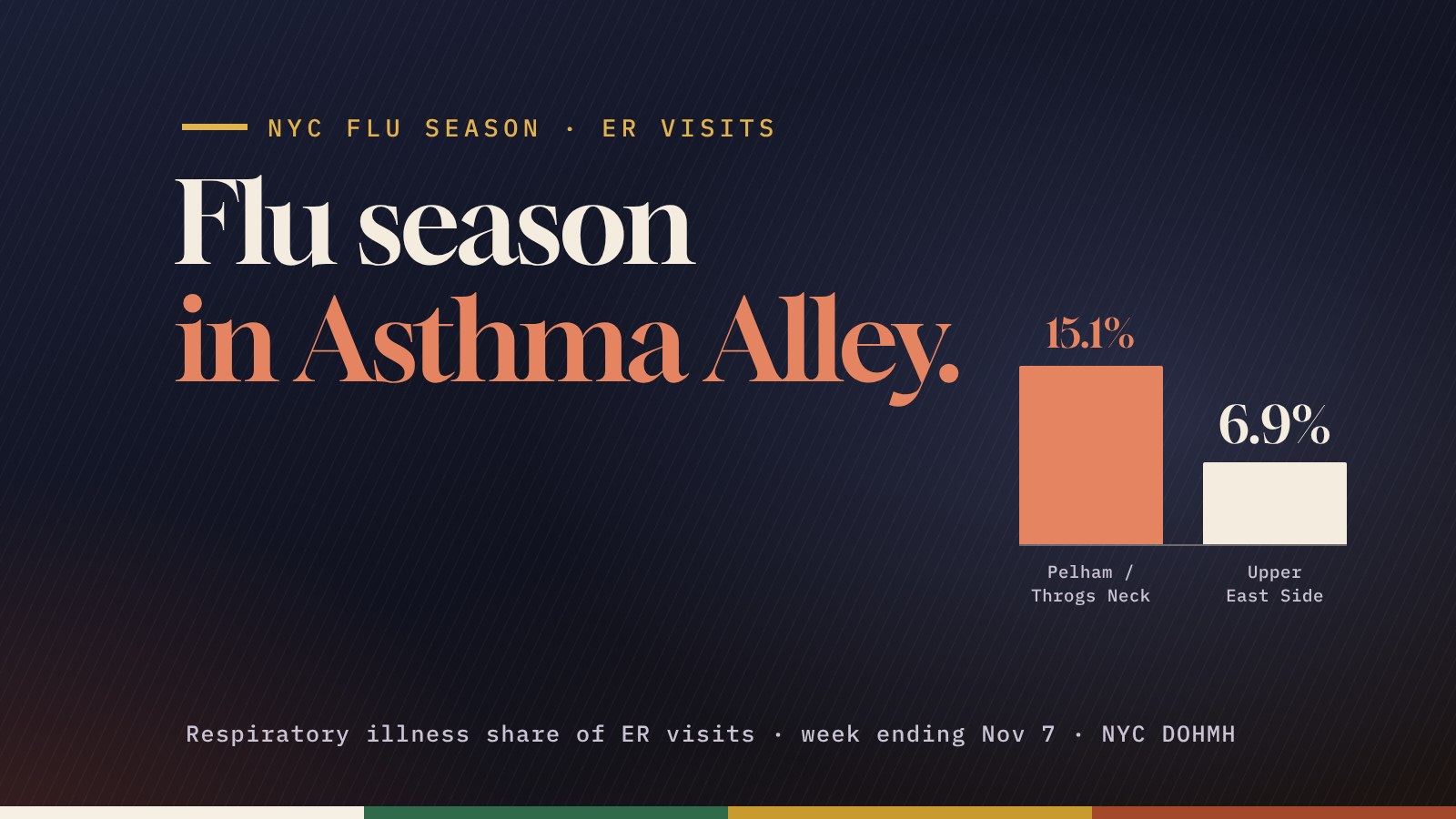
- Emergency Room Spikes in Black and Latino Neighborhoods: Surveillance data from the NYC Department of Health and Mental Hygiene for the week ending November 7, 2026 shows overall respiratory illness emergency department (ED) visits climbing to 11.4% citywide (with flu-specific ED visits jumping from 1.28% to 2.11% in one week). Neighborhood-level data shows some of the city’s sharpest spikes occurring in Black and Latino communities across the Bronx and Upper Manhattan—reaching 15.1% of all ED visits in Pelham/Throgs Neck, 13.6% in Fordham/Bronx Park, 12.0% in Central Harlem/Morningside Heights, and 11.9% in East Harlem, compared to just 6.9% on the Upper East Side.
The Biological Link: Flu Symptoms, Asthma, and Pollution-Induced Immune Deficiency
For a healthy adult living in a low-pollution neighborhood, influenza typically causes two weeks of fever, body aches, chills, sore throat, cough, and fatigue. Inside the South Bronx and East Harlem, however, the flu acts as a dangerous catalyst for severe respiratory failure:
- Severe Asthma Exacerbations: As the Centers for Disease Control and Prevention (CDC) warns, people with asthma already live with chronically swollen, hyper-sensitive airways. When the influenza virus infects the respiratory tract, it triggers acute airway inflammation, bronchospasms, and fluid buildup—turning routine flu symptoms into life-threatening asthma attacks and secondary bacterial pneumonia. In fact, a spatial and time-series study published in PMC / National Library of Medicine confirmed that influenza and asthma hospitalizations in New York City are directly correlated, with the Bronx and Manhattan exhibiting the highest excess risk of influenza-triggered asthma hospitalizations across all five boroughs.
- Double to Six Times Higher Pediatric Asthma Rates: According to data highlighted by the NYC Mayor’s Office and Word In Black, pediatric asthma rates and ER visits in the Bronx remain double the national average. Public health research compiled on SSRN notes that children’s asthma-related ED visits in high-poverty Bronx neighborhoods are more than six times higher than in wealthier areas of the city, while South Bronx Unite has documented localized asthma hospitalization rates up to 21 times higher than in affluent parts of Manhattan. Nationally, an October 2026 analysis by the NAACP confirmed that New York City’s heaviest asthma hotspot sits in the Bronx (Congressional District NY-15), and that Black Americans are five times more likely to visit the ER for asthma and twice as likely to die from it compared to white Americans.
- Air Pollution and Immune Suppression: Chronic exposure to highway diesel exhaust and particulate matter does not just irritate lungs—it suppresses the body’s immune defenses. Research by scientists at Stanford University and UC Berkeley, reported by UC Berkeley Research, demonstrated that ambient air pollution suppresses regulatory T cells (Treg)—key immune cells responsible for controlling inflammatory responses—resulting in lower lung capacity and more severe respiratory flare-ups. Furthermore, a systematic review published in PMC / National Library of Medicine confirmed that prolonged exposure to PM2.5 and nitrogen oxides causes oxidative stress, impairs mucosal immunity, and significantly increases both the likelihood of contracting influenza and the severity of flu symptoms.
- Indoor Housing Triggers and Urban Heat: As Bronx Borough President Vanessa L. Gibson noted in an August 2026 analysis for Citizens Union’s Searchlight, aging public and rent-stabilized housing plagued by water leaks, toxic mold, and poor ventilation compounds outdoor air pollution—while NYC Health Department climate data shows East Harlem and the South Bronx endure elevated urban heat-island temperatures that trap ground-level ozone and strain cardiovascular and immune systems year-round.
Following the Climate Money: Is the CLCPA Fixing Communities—or Fueling “Green Gentrification”?
In 2019, New York passed the Climate Leadership and Community Protection Act (CLCPA), requiring state agencies to direct at least 35%—with a goal of 40% to 45%—of clean-energy, energy-efficiency, and pollution-reduction benefits to designated Disadvantaged Communities (DACs), including nearly the entire South Bronx and East Harlem.
While targeted investments have begun rolling out, major gaps threaten both health equity and housing stability:
- Targeted Asthma Mitigation vs. Scale of Need: In May 2026, Mayor Zohran Mamdani and the NYC Health Department announced $20 million in MTA congestion-pricing mitigation funds dedicated to childhood asthma in the Bronx—allocating $8.9 million to a community-based Bronx Asthma Program and $11.1 million to expand in-school asthma case management and medication access across 15 additional Bronx schools, building on earlier $15 million investments in Hunts Point refrigerated truck electrification and $20 million for clean trucks. Yet advocates such as South Bronx Unite have warned that congestion pricing risks diverting diesel truck traffic onto the Cross Bronx Expressway while delivering only modest health funding relative to decades of respiratory harm. Moreover, New York’s Climate Act reporting framework does not automatically guarantee direct indoor health upgrades—like HEPA filtration, mold remediation, and electric heat pumps—for low-income Black and Latino tenants.
- The “Green Gentrification” Trap: Worse, when waterfront parks and green stormwater infrastructure arrive in redlined neighborhoods without anti-displacement protections, environmental upgrades routinely trigger green gentrification. A spatial analysis of New York City green infrastructure published via the CUNY Graduate Center found that gentrification hotspots across the city strongly correlated with new green stormwater and resilience investments—driving up surrounding rents and property values along the Harlem River in East Harlem (NYC Parks Vision Plan for a Resilient East Harlem) and the South Bronx waterfront while pushing out the Black and Latino families who endured decades of pollution.
Policy Solutions: Protecting Lungs, Immune Systems, and Housing Stability
To ensure climate investments genuinely heal Black, Latino, and Afro-Latino communities during peak respiratory virus seasons and summer heatwaves alike, organizations like the Afro-Latino Association for Policy & Advocacy (ALAPA) are calling for four urgent policy actions:
- Deploy Free Indoor Air Filtration and Flu/Asthma Rapid Response in High-Risk Zip Codes: Dedicate CLCPA and congestion-pricing mitigation dollars to provide free medical-grade HEPA air purifiers, mold remediation, and mobile vaccination/antiviral clinics directly inside NYCHA developments and rent-stabilized buildings across the South Bronx and Upper Manhattan.
- Enforce Direct Household Benefits Under the CLCPA: Require NYSERDA and city housing agencies to direct at least 40% of clean-energy retrofit funds into public and affordable housing—replacing gas stoves and oil boilers with electric heat pumps and cooling systems at zero cost to tenants.
- Pair Every Green Project with Anti-Displacement Guardrails: Mandate that any neighborhood receiving state CLCPA resilience grants or city waterfront park investments automatically enact strict Good Cause Eviction enforcement, commercial rent stabilization, and right-of-first-refusal funding for Community Land Trusts (CLTs) so speculators cannot capture public green investments.
- Disaggregate Respiratory and Environmental Health Data for Afro-Latinos: Require the NYC Department of Health and State Department of Health to track flu hospitalizations, asthma ER visits, and vaccination rates using disaggregated race and ethnicity data so Afro-Latino households are visibly accounted for in public health responses.
Dr. Richard Nuñez-Lawrence is the founding Executive Director of the Afro-Latino Association for Policy and Advocacy (ALAPA).
Mientras una temporada de gripe temprana y agresiva recorre la ciudad de Nueva York este otoño, las salas de emergencia del Bronx y el Alto Manhattan vuelven a estar en primera línea de un choque de salud pública previsible y evitable.
Durante generaciones, los mapas federales de redlining y la zonificación industrial convirtieron los barrios históricamente negros, latinos y afrolatinos de Nueva York —en especial el Sur del Bronx y East Harlem— en zonas de sacrificio ambiental. Rodeadas por la autopista Cross Bronx, la Major Deegan, la FDR Drive, estaciones de transferencia de residuos comerciales y plantas eléctricas de combustibles fósiles para horas pico, las familias de estas comunidades llevan mucho tiempo respirando niveles desproporcionados de partículas finas (PM2,5), dióxido de nitrógeno y gases de diésel.
Hoy, cuando un brote de influenza inusualmente temprano en 2026 coincide con el asma crónica, sistemas inmunológicos debilitados por la contaminación y olas de calor cada vez más intensas por el cambio climático, surge una pregunta de política pública crucial para los neoyorquinos afrolatinos: ¿las inversiones climáticas estatales y municipales realmente están sanando a las comunidades vulnerables, o están alimentando una «gentrificación verde» mientras los residentes siguen expuestos a emergencias respiratorias?
El brote de gripe de noviembre de 2026: por qué los virus respiratorios golpean más al «Callejón del Asma»
La temporada de influenza 2026–2027 llegó a Nueva York semanas antes de lo previsto y está golpeando con fuerza desproporcionada a los barrios con altas tasas de asma:
- Casos que suben un 50 % en una sola semana: Según el Departamento de Salud del Estado de Nueva York, los casos de gripe confirmados por laboratorio en el estado superaron los 30.000 al 7 de noviembre de 2026, con 12.006 casos nuevos y 871 hospitalizaciones registrados en una sola semana, un aumento semanal del 50 % en las infecciones. Como informó PIX11, las hospitalizaciones semanales se dispararon un 105 % a principios de noviembre, con más de 4.300 casos de gripe confirmados en la ciudad de Nueva York en una sola semana, y el Bronx, Manhattan, Kings y Queens a la cabeza del estado en número de casos.
- Picos en las salas de emergencia de los barrios negros y latinos: Los datos de vigilancia del Departamento de Salud e Higiene Mental de la Ciudad de Nueva York para la semana que terminó el 7 de noviembre de 2026 muestran que las visitas a emergencias por enfermedades respiratorias subieron al 11,4 % en toda la ciudad (y las visitas específicas por gripe pasaron del 1,28 % al 2,11 % en una semana). Los datos por barrio muestran algunos de los picos más pronunciados de la ciudad en comunidades negras y latinas del Bronx y el Alto Manhattan: el 15,1 % de todas las visitas a emergencias en Pelham/Throgs Neck, el 13,6 % en Fordham/Bronx Park, el 12,0 % en Central Harlem/Morningside Heights y el 11,9 % en East Harlem, frente a solo el 6,9 % en el Upper East Side.
El vínculo biológico: síntomas de gripe, asma e inmunodeficiencia causada por la contaminación
Para un adulto sano que vive en un barrio con poca contaminación, la influenza suele causar dos semanas de fiebre, dolores corporales, escalofríos, dolor de garganta, tos y cansancio. En el Sur del Bronx y East Harlem, en cambio, la gripe actúa como un catalizador peligroso de insuficiencia respiratoria grave:
- Crisis de asma graves: Como advierten los Centros para el Control y la Prevención de Enfermedades (CDC), las personas con asma ya viven con vías respiratorias crónicamente inflamadas e hipersensibles. Cuando el virus de la influenza infecta el aparato respiratorio, desencadena inflamación aguda de las vías respiratorias, broncoespasmos y acumulación de líquido, lo que convierte síntomas comunes de la gripe en ataques de asma potencialmente mortales y en neumonías bacterianas secundarias. De hecho, un estudio espacial y de series temporales publicado en PMC / Biblioteca Nacional de Medicina confirmó que las hospitalizaciones por influenza y por asma en Nueva York están directamente relacionadas, y que el Bronx y Manhattan presentan el mayor exceso de riesgo de hospitalizaciones por asma desencadenadas por la gripe de los cinco condados.
- Tasas de asma infantil de dos a seis veces mayores: Según datos destacados por la Oficina del Alcalde de Nueva York y Word In Black, las tasas de asma infantil y las visitas a emergencias en el Bronx siguen duplicando el promedio nacional. Investigaciones de salud pública recopiladas en SSRN señalan que las visitas de niños a emergencias por asma en los barrios más pobres del Bronx son más de seis veces mayores que en las zonas más ricas de la ciudad, mientras que South Bronx Unite ha documentado tasas locales de hospitalización por asma hasta 21 veces mayores que en zonas acomodadas de Manhattan. A nivel nacional, un análisis de la NAACP de octubre de 2026 confirmó que el mayor foco de asma de Nueva York está en el Bronx (distrito congresional NY-15), y que las personas negras en Estados Unidos tienen cinco veces más probabilidades de ir a emergencias por asma y el doble de probabilidades de morir por esa causa que las personas blancas.
- Contaminación del aire e inmunosupresión: La exposición crónica a los gases de diésel de las autopistas y a las partículas en suspensión no solo irrita los pulmones: también debilita las defensas inmunológicas. Investigaciones de científicos de la Universidad de Stanford y de UC Berkeley, difundidas por UC Berkeley Research, demostraron que la contaminación del aire suprime las células T reguladoras (Treg), células inmunitarias clave que controlan la respuesta inflamatoria, lo que reduce la capacidad pulmonar y agrava las crisis respiratorias. Además, una revisión sistemática publicada en PMC / Biblioteca Nacional de Medicina confirmó que la exposición prolongada a PM2,5 y a óxidos de nitrógeno provoca estrés oxidativo, debilita la inmunidad de las mucosas y aumenta significativamente tanto la probabilidad de contraer influenza como la gravedad de sus síntomas.
- Detonantes en la vivienda y calor urbano: Como señaló la presidenta del condado del Bronx, Vanessa L. Gibson, en un análisis de agosto de 2026 para Searchlight, de Citizens Union, la vivienda pública y de renta estabilizada envejecida, con filtraciones de agua, moho tóxico y mala ventilación, agrava la contaminación del aire exterior, mientras que los datos climáticos del Departamento de Salud de la ciudad muestran que East Harlem y el Sur del Bronx sufren temperaturas elevadas por el efecto de isla de calor urbana, que atrapan el ozono a nivel del suelo y someten a los sistemas cardiovascular e inmunológico a un esfuerzo constante durante todo el año.
Siguiendo el dinero climático: ¿la CLCPA está reparando a las comunidades o alimentando la «gentrificación verde»?
En 2019, Nueva York aprobó la Ley de Liderazgo Climático y Protección Comunitaria (CLCPA), que obliga a las agencias estatales a destinar al menos el 35 % —con una meta del 40 % al 45 %— de los beneficios de energía limpia, eficiencia energética y reducción de la contaminación a las Comunidades Desfavorecidas (DAC) designadas, entre ellas casi todo el Sur del Bronx y East Harlem.
Aunque ya han comenzado a llegar inversiones específicas, persisten grandes vacíos que amenazan tanto la equidad en salud como la estabilidad de la vivienda:
- Mitigación del asma frente a la magnitud de la necesidad: En mayo de 2026, el alcalde Zohran Mamdani y el Departamento de Salud de la ciudad anunciaron 20 millones de dólares de los fondos de mitigación de la tarifa por congestión de la MTA dedicados al asma infantil en el Bronx: 8,9 millones para un Programa Comunitario de Asma del Bronx y 11,1 millones para ampliar la gestión de casos de asma en las escuelas y el acceso a medicamentos en 15 escuelas más del Bronx. Estos fondos se suman a inversiones anteriores de 15 millones para electrificar camiones refrigerados en Hunts Point y de 20 millones para camiones limpios. Sin embargo, defensores como South Bronx Unite han advertido que la tarifa por congestión podría desviar el tráfico de camiones diésel hacia la autopista Cross Bronx, mientras aporta fondos de salud modestos frente a décadas de daño respiratorio. Además, el marco de informes de la Ley Climática de Nueva York no garantiza automáticamente mejoras directas de salud en el interior de las viviendas —como filtración HEPA, eliminación de moho y bombas de calor eléctricas— para los inquilinos negros y latinos de bajos ingresos.
- La trampa de la «gentrificación verde»: Peor aún, cuando llegan parques junto al agua e infraestructura verde para aguas pluviales a barrios marcados por el redlining sin protecciones contra el desplazamiento, las mejoras ambientales suelen desencadenar gentrificación verde. Un análisis espacial de la infraestructura verde de Nueva York publicado a través del CUNY Graduate Center encontró que los focos de gentrificación de la ciudad estaban fuertemente relacionados con nuevas inversiones verdes en aguas pluviales y resiliencia, que encarecen los alquileres y el valor de las propiedades a lo largo del río Harlem en East Harlem (Plan de Visión de NYC Parks para un East Harlem Resiliente) y en la costa del Sur del Bronx, mientras expulsan a las familias negras y latinas que soportaron décadas de contaminación.
Soluciones de política pública: proteger los pulmones, el sistema inmunológico y la estabilidad de la vivienda
Para que las inversiones climáticas sanen de verdad a las comunidades negras, latinas y afrolatinas, tanto en los picos de virus respiratorios como en las olas de calor del verano, organizaciones como la Asociación Afrolatina de Política y Defensa (ALAPA) piden cuatro medidas urgentes:
- Ofrecer filtración de aire gratuita y respuesta rápida contra la gripe y el asma en los códigos postales de alto riesgo: Destinar fondos de la CLCPA y de mitigación de la tarifa por congestión a entregar purificadores de aire HEPA de grado médico, eliminar el moho y llevar clínicas móviles de vacunación y antivirales directamente a los complejos de NYCHA y a los edificios de renta estabilizada del Sur del Bronx y el Alto Manhattan.
- Hacer cumplir los beneficios directos para los hogares bajo la CLCPA: Exigir que NYSERDA y las agencias de vivienda de la ciudad destinen al menos el 40 % de los fondos de modernización energética a la vivienda pública y asequible, para reemplazar estufas de gas y calderas de petróleo por bombas de calor y sistemas de enfriamiento eléctricos sin costo para los inquilinos.
- Acompañar cada proyecto verde con protecciones contra el desplazamiento: Exigir que todo barrio que reciba subvenciones estatales de resiliencia de la CLCPA o inversiones municipales en parques junto al agua aplique automáticamente una protección estricta contra desalojos sin causa justificada (Good Cause Eviction), la estabilización de rentas comerciales y fondos de derecho de preferencia para los Fideicomisos Comunitarios de Tierras (CLT), de modo que los especuladores no se queden con las inversiones verdes públicas.
- Desagregar los datos de salud respiratoria y ambiental para los afrolatinos: Exigir que los departamentos de Salud de la ciudad y del estado registren las hospitalizaciones por gripe, las visitas a emergencias por asma y las tasas de vacunación con datos desagregados por raza y etnia, para que los hogares afrolatinos sean visibles en la respuesta de salud pública.
El Dr. Richard Nuñez-Lawrence es el director ejecutivo fundador de la Asociación Afrolatina de Política y Defensa (Afro-Latino Association for Policy and Advocacy, ALAPA).
ALAPA, the Afro-Latino Association for Policy & Advocacy, is a New York nonprofit for Afro-Latinos across the Americas and the Caribbean.ALAPA, la Afro-Latino Association for Policy & Advocacy, es una organización sin fines de lucro de Nueva York para la comunidad afrolatina de las Américas y el Caribe.