In Memoriam: Dolores Huerta, the Indomitable Voice of ‘Sí, Se Puede,’ Dies at 96In memoriam: Dolores Huerta, la voz indomable del ‘Sí, se puede’, muere a los 96 años
Civil rights titan, labor pioneer and feminist icon, Dolores Huerta spent seven decades building solidarity across communities. Her life is a challenge to the rest of us.Titán de los derechos civiles, pionera del movimiento obrero e ícono feminista, Dolores Huerta dedicó siete décadas a tender puentes de solidaridad entre comunidades. Su vida es un desafío para todos nosotros.
 ByPor Dr. Richard Nuñez-Lawrence, Founding Executive Director, ALAPADirector ejecutivo fundador de ALAPA4 min readmin de lectura
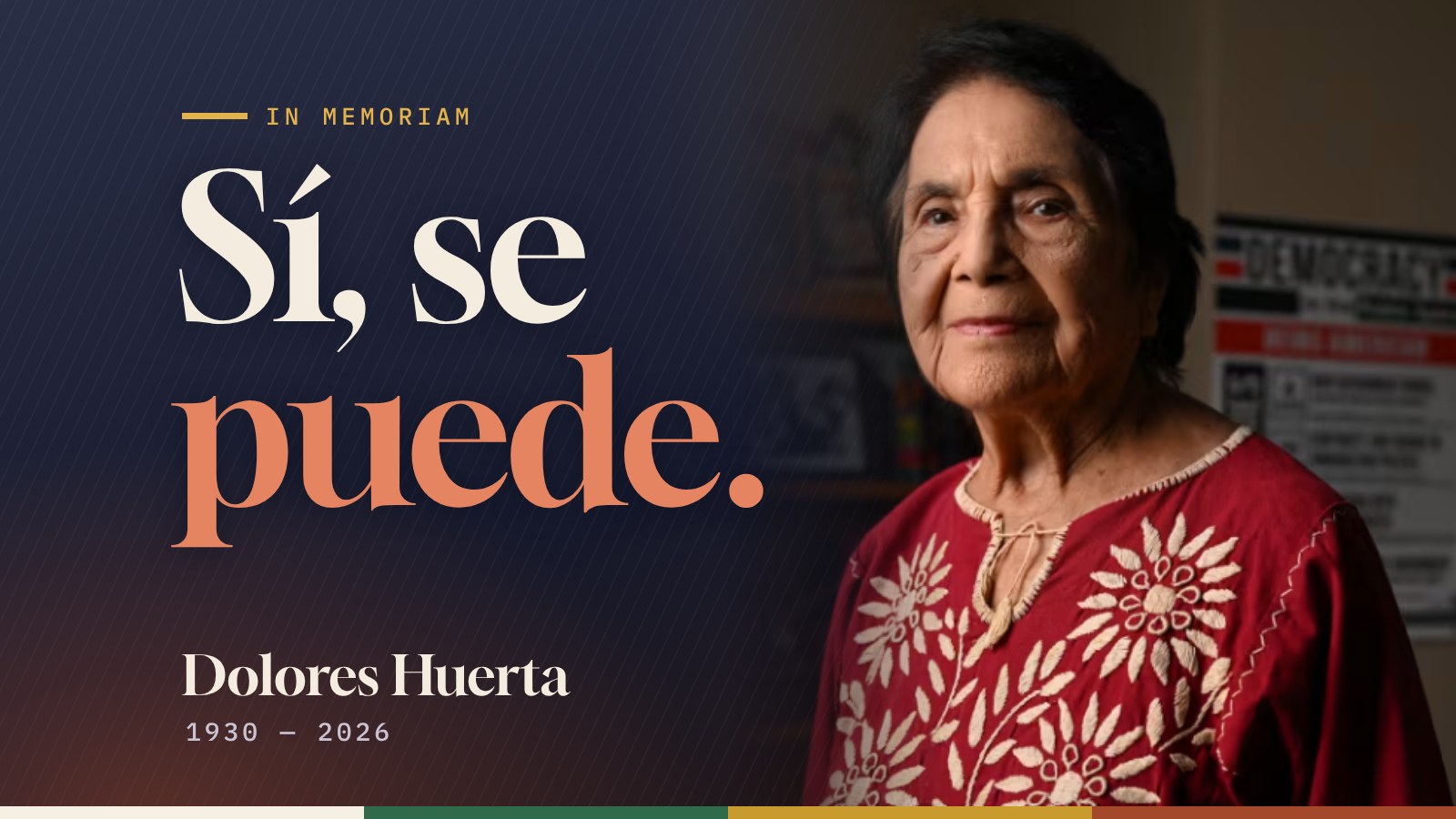
Civil rights titan, labor pioneer, and feminist icon Dolores Huerta passed away today, October 28, 2026, at her home in Bakersfield, California. She was 96 years old.
Her family confirmed her passing from cancer, prompting an immediate wave of national mourning and profound reflection on a legacy that fundamentally transformed American labor and social justice. Across seven decades of unrelenting activism, Huerta served as the fierce backbone of the farmworker movement, a champion for women and immigrants, and a bridge of solidarity connecting diverse marginalized communities.
A History Built on Picket Lines and Uncomfortable Truths
Born Dolores Clara Fernández on April 10, 1930, in Dawson, New Mexico, Huerta was raised by a fiercely independent businesswoman mother in the agricultural town of Stockton, California. She briefly pursued teaching but quickly realized her true calling lay outside the classroom. As she famously recalled, "I couldn't stand seeing kids come to class hungry and needing shoes. I thought I could do more by organizing farmworkers than by trying to teach their hungry children."
In 1962, alongside César Chávez and Gilbert Padilla, she co-founded the National Farm Workers Association, which later became the United Farm Workers (UFW). While Chávez became the public face of the movement, Huerta was its master strategist and chief negotiator. She stood on cars with bullhorns, directed the historic 1965 Delano Grape Strike, and single-handedly coordinated nationwide consumer boycotts that forced multi-million-dollar agribusinesses to grant basic human rights—like field toilets, rest breaks, and protection from toxic pesticides—to farmworkers.
Huerta was the literal author of the movement’s most enduring chant, “Sí, se puede!” (“Yes, we can!”), a phrase later adopted by Barack Obama for his historic 2008 presidential campaign.
Her final year of life was marked by an immense act of historical courage. In early 2026, breaking a 60-year silence, Huerta publicly revealed that she had been sexually assaulted and raped by César Chávez during the height of the 1960s movement. She explained that she had hidden the pain for decades out of fear that exposing the truth would derail the progress of the workers. Her bravery in speaking out exemplified a core truth she lived by: that solidarity never requires silence, and true justice demands accountability, no matter how painful.
Beyond Boundaries: Solidarity with Black Communities
Dolores Huerta understood that the fight for human rights could never exist in a vacuum. Long before the term "intersectionality" entered mainstream vocabulary, Huerta was practicing it by forging deep, lifelong coalitions with Black civil rights leaders and communities.
- The Civil Rights Nexus: During the 1960s, Huerta locked arms with leaders of the broader Civil Rights Movement, explicitly drawing parallels between the economic disenfranchisement of Black Americans and the exploitation of Latino migrant workers.
- The Black Panther Coalition: In the late 1960s, Huerta collaborated closely with the Black Panther Party in Oakland, supporting their Free Breakfast for Children programs, while the Panthers actively enforced and promoted the UFW’s grape boycotts in urban areas.
- A Unified Democratic Front: Her intersectional coalition-building extended deep into the political sphere. She stood closely beside Robert F. Kennedy during his historic 1968 campaign, working to build a political alliance that united Black and Latino voters against systemic poverty.
A Global Family Tree: The Afro-Latino Legacy
Huerta’s commitment to multicultural solidarity was not just political; it was deeply personal. A mother of 13 children, she watched her family grow into a sprawling, multiracial tapestry that mirrors the exact diverse coalition she spent her life organizing.
Among her 24 grandchildren and numerous great-grandchildren are Afro-Latino descendants, born from the intersections of Black and Latino heritage. Her Afro-Latino grandchildren embody the exact bridge of shared struggle and cultural fusion that Huerta championed on the global stage. For Huerta, the presence of Afro-Latino identity in her immediate family tree was a daily reminder that the liberation of Black and Brown communities is inextricably linked.
The Call to Action: Carrying the Flame
The passing of Dolores Huerta marks the end of an era, but her death is fundamentally a challenge, not just a legacy. Even well into her 90s, when she could have easily retired, she was still marching, protesting, and using her Dolores Huerta Foundation to train the grassroots organizers of tomorrow.
Her family and peers emphasize that the most profound monument to Dolores Huerta is not built of brick, stone, or marble, nor is it a grand public clock tower. The true memorial to Dolores Huerta is the movement itself. As community advocates frequently note in moments of historical reckoning: "The movement—that’s the hero."
The ultimate tribute to her memory is to pick up her bullhorn. As we confront enduring disparities in labor, racial equity, and bodily autonomy, her life's work reminds us that real power never trickles down from the wealthy or well-connected—it rises collectively from the ground up.
Dolores Huerta has laid down her march. The battle for justice and equality now rests firmly in our hands.
Sí, se puede. Always.
Dr. Richard Nuñez-Lawrence is the founding Executive Director of the Afro-Latino Association for Policy and Advocacy (ALAPA).
Dolores Huerta, titán de los derechos civiles, pionera del movimiento obrero e ícono feminista, falleció hoy, 28 de octubre de 2026, en su casa de Bakersfield, California. Tenía 96 años.
Su familia confirmó que murió de cáncer. La noticia desató de inmediato una ola de duelo en todo el país y una profunda reflexión sobre un legado que transformó de raíz los derechos laborales y la justicia social en Estados Unidos. A lo largo de siete décadas de activismo incansable, Huerta fue la columna vertebral del movimiento de los trabajadores agrícolas, una defensora de las mujeres y de los inmigrantes, y un puente de solidaridad entre diversas comunidades marginadas.
Una historia forjada en los piquetes y en verdades incómodas
Nacida como Dolores Clara Fernández el 10 de abril de 1930 en Dawson, Nuevo México, Huerta se crió en Stockton, un pueblo agrícola de California, bajo la crianza de una madre empresaria y ferozmente independiente. Se dedicó brevemente a la enseñanza, pero pronto comprendió que su verdadera vocación estaba fuera del aula. Como ella misma recordaba: «No soportaba ver a los niños llegar a clase con hambre y sin zapatos. Pensé que podía hacer más organizando a los trabajadores agrícolas que tratando de enseñarles a sus hijos hambrientos».
En 1962, junto a César Chávez y Gilbert Padilla, cofundó la Asociación Nacional de Trabajadores Agrícolas (National Farm Workers Association), que más tarde se convirtió en la Unión de Campesinos (United Farm Workers, UFW). Mientras Chávez se convertía en el rostro público del movimiento, Huerta era su gran estratega y su principal negociadora. Se subía a los autos con megáfono en mano, dirigió la histórica huelga de la uva de Delano de 1965 y coordinó por sí sola boicots de consumidores a nivel nacional que obligaron a empresas agroindustriales multimillonarias a reconocer derechos humanos básicos a los trabajadores del campo, como baños en los campos, descansos y protección contra pesticidas tóxicos.
Huerta fue la autora del lema más perdurable del movimiento, «¡Sí, se puede!», una frase que Barack Obama adoptó más tarde en inglés («Yes, we can!») para su histórica campaña presidencial de 2008.
El último año de su vida estuvo marcado por un inmenso acto de valentía histórica. A comienzos de 2026, rompiendo un silencio de 60 años, Huerta reveló públicamente que César Chávez la había agredido sexualmente y violado en el apogeo del movimiento, en los años sesenta. Explicó que había ocultado ese dolor durante décadas por temor a que la verdad frenara los avances de los trabajadores. Su valentía al hablar reflejó una verdad fundamental de su vida: la solidaridad nunca exige silencio, y la verdadera justicia exige rendición de cuentas, por doloroso que sea.
Más allá de las fronteras: solidaridad con las comunidades negras
Dolores Huerta entendía que la lucha por los derechos humanos nunca podía darse de forma aislada. Mucho antes de que el término «interseccionalidad» se popularizara, Huerta ya lo practicaba, forjando alianzas profundas y duraderas con líderes y comunidades negras del movimiento por los derechos civiles.
- El vínculo con los derechos civiles: En los años sesenta, Huerta se unió a líderes del movimiento por los derechos civiles y trazó paralelos explícitos entre la exclusión económica de los afroestadounidenses y la explotación de los trabajadores migrantes latinos.
- La alianza con los Panteras Negras: A finales de los sesenta, Huerta colaboró estrechamente con el Partido Pantera Negra en Oakland y apoyó sus programas de desayunos gratuitos para niños, mientras los Panteras promovían y hacían cumplir activamente los boicots de la uva de la UFW en las zonas urbanas.
- Un frente democrático unido: Su trabajo de alianzas interseccionales llegó hasta la esfera política. Acompañó de cerca a Robert F. Kennedy durante su histórica campaña de 1968, trabajando para construir una alianza política que uniera a votantes negros y latinos contra la pobreza sistémica.
Un árbol familiar global: el legado afrolatino
El compromiso de Huerta con la solidaridad multicultural no era solo político; era profundamente personal. Madre de 13 hijos, vio crecer a su familia hasta convertirse en un tejido amplio y multirracial que refleja la misma coalición diversa que pasó su vida organizando.
Entre sus 24 nietos y numerosos bisnietos hay descendientes afrolatinos, nacidos del encuentro entre la herencia negra y la latina. Sus nietos afrolatinos encarnan el mismo puente de lucha compartida y fusión cultural que Huerta defendió en el escenario mundial. Para Huerta, la presencia de la identidad afrolatina en su propia familia era un recordatorio diario de que la liberación de las comunidades negras y morenas está inseparablemente unida.
Un llamado a la acción: mantener viva la llama
La partida de Dolores Huerta marca el fin de una era, pero su muerte es, ante todo, un desafío y no solo un legado. Incluso pasados los 90 años, cuando bien pudo haberse retirado, seguía marchando, protestando y formando a los organizadores comunitarios del mañana a través de su Fundación Dolores Huerta.
Su familia y sus compañeros de lucha subrayan que el monumento más profundo a Dolores Huerta no está hecho de ladrillo, piedra ni mármol, ni es una gran torre de reloj en una plaza pública. El verdadero homenaje a Dolores Huerta es el movimiento mismo. Como suelen decir los defensores comunitarios en momentos de ajuste de cuentas con la historia: «El movimiento: ese es el héroe».
El mayor tributo a su memoria es tomar su megáfono. Ante las desigualdades persistentes en el trabajo, la equidad racial y la autonomía corporal, la obra de su vida nos recuerda que el verdadero poder nunca baja desde los ricos ni los bien conectados; surge colectivamente desde abajo.
Dolores Huerta ha terminado su marcha. La lucha por la justicia y la igualdad queda ahora firmemente en nuestras manos.
Sí, se puede. Siempre.
El Dr. Richard Nuñez-Lawrence es el director ejecutivo fundador de la Asociación Afrolatina de Política y Defensa (Afro-Latino Association for Policy and Advocacy, ALAPA).
ALAPA, the Afro-Latino Association for Policy & Advocacy, is a New York nonprofit for Afro-Latinos across the Americas and the Caribbean.ALAPA, la Afro-Latino Association for Policy & Advocacy, es una organización sin fines de lucro de Nueva York para la comunidad afrolatina de las Américas y el Caribe.