Broken Windows Rebranded: What the Data Reveals About Over-Policing in New York City’s Black and Latino Neighborhoods Today«Ventanas rotas» con otro nombre: lo que revelan los datos sobre el exceso de vigilancia policial en los barrios negros y latinos de Nueva York hoy
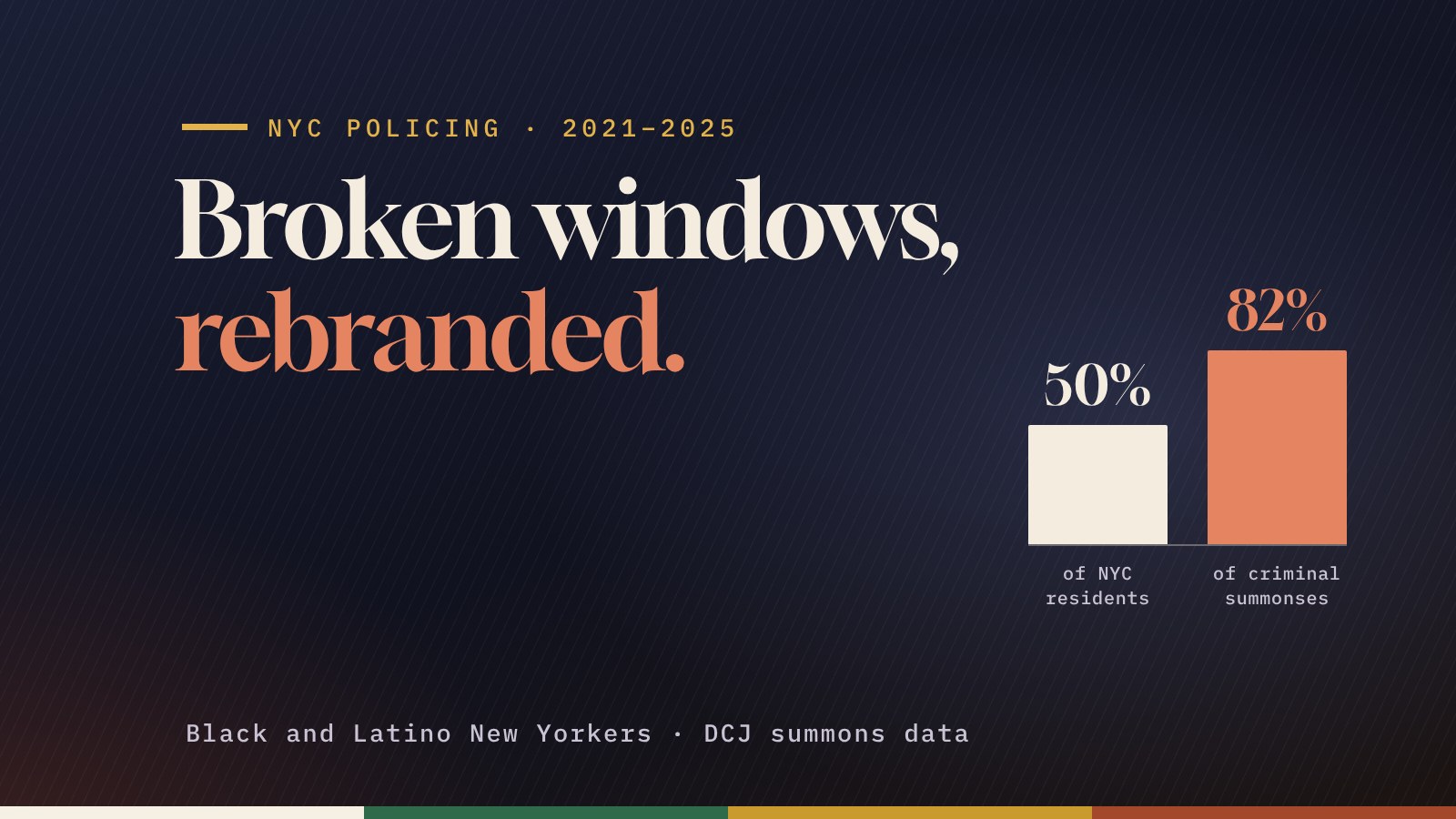
Low-level enforcement is surging again in New York City. Black and Latino residents are half the population but received 81.8% of criminal summonses, and police data still can’t show how Afro-Latinos are affected.La aplicación de la ley por faltas menores vuelve a dispararse en Nueva York. Los residentes negros y latinos son la mitad de la población, pero recibieron el 81,8 % de las citaciones penales, y los datos policiales aún no muestran cómo se ven afectados los afrolatinos.
 ByPor Dr. Richard Nuñez-Lawrence, Founding Executive Director, ALAPADirector ejecutivo fundador de ALAPA5 min readmin de lectura
When Mayor Zohran Mamdani took office in January 2026 after campaigning on a public-health vision of safety that rejected punitive “quality-of-life” policing, civil rights advocates expected a decisive break from New York City’s past. Yet less than a year into the administration, public defenders, court monitors, and data researchers are sounding an alarm: low-level enforcement in Black and Latino neighborhoods is surging once again.
For Afro-Latino New Yorkers—who navigate the intersection of anti-Black racial profiling and anti-Latino bias—this resurgence feels painfully familiar. Examining newly released 2025 and 2026 enforcement data alongside the legacy of Rudy Giuliani’s 1990s “Broken Windows” regime reveals whether claims of modern over-policing hold up under statistical scrutiny, how municipal databases erase Afro-Latino identity, and what proven strategies can keep New York safe without criminalizing communities of color.
Then vs. Now: Comparing Giuliani’s “Broken Windows” to 2026 Enforcement
Under Mayor Rudy Giuliani and Police Commissioner William Bratton in the 1990s, the NYPD institutionalized “Broken Windows” policing—a strategy predicated on the theory that aggressively arresting and ticketing people for minor infractions like turnstile jumping, loitering, public drinking, and marijuana possession would deter violent felonies. As documented in criminological analyses published in the African Journal of Criminology and Justice Studies, the 1990s strategy produced massive racial disparities in misdemeanor arrests while failing to prove that low-level crackdowns caused the decade’s crime drop.
In 2026, total raw arrest numbers remain lower than their 1990s and early-2000s peaks, and NYPD Commissioner Jessica Tisch has framed modern Quality of Life divisions around addressing “daily nuisances” rather than using minor infractions as a pretext for felony prevention. However, the statistical data confirms that the claim of modern over-policing in Black and Latino neighborhoods is entirely valid:
- A Five-Fold Surge in Criminal Summonses: According to the New York City Criminal Summons Dashboard launched in November 2026 by the Data Collaborative for Justice (DCJ), criminal summonses issued by the NYPD jumped nearly fivefold between 2021 and 2025. While Black residents make up 21.9% of New York City’s population and Hispanic or Latino residents account for 28.5%, Black New Yorkers received 47.5% of all criminal summonses and Hispanic New Yorkers received 34.3%—meaning Black and Latino residents absorbed 81.8% of low-level citations. Fewer than 10% of those summonses even resulted in a conviction.
- 220,802 Low-Level Summonses in FY 2026: As reported by the New York Daily News and The Legal Aid Society, the Mayor’s Fiscal Year 2026 Management Report—covering the final six months of the Adams administration and the first six months of the Mamdani administration—showed the NYPD issued 220,802 low-level summonses, a 13% increase over the prior fiscal year.
- Arraignment and Arrest Disparities: According to official city metrics published by EquityNYC, overall NYPD arrests rose for five consecutive years—jumping 99% between 2020 and 2025—with Black and Hispanic New Yorkers accounting for 83% of all arrests and 88% of youth in detention. Meanwhile, court-monitoring data compiled in August 2026 by Court Watch NYC and reported by the Queens Daily Eagle found that 57% of observed arraignments were misdemeanors and 93% targeted people of color.
- The Return of Street and Vehicle Stops: EquityNYC data shows recorded Stop, Question, and Frisk encounters nearly tripled since 2021 to reach 26,631 in 2025, with Black New Yorkers stopped at nearly 14 times the rate of white New Yorkers. An August 2026 federal monitor report cited by the Legal Defense Fund (LDF) found that 91% of individuals stopped by NYPD specialized units were Black or Hispanic, with unconstitutional frisks and searches routinely rubber-stamped in internal audits. Simultaneously, an analysis by the Community Service Society of New York (CSSNY) found that NYPD vehicle searches surged 83% in 2024 to 28,416 searches, with over 84% targeting Black or Latino drivers.
Over-Surveillance and the Afro-Latino Blind Spot in Justice Data
For Afro-Latino residents in neighborhoods like East Harlem, Mott Haven, Bushwick, and Crown Heights, aggressive quality-of-life enforcement compounds a unique structural vulnerability. On the street, officers profile Afro-Latinos through anti-Black racial heuristics—subjecting them to heightened stop rates, vehicle searches, and inclusion in the NYPD’s controversial Criminal Group Database, where an audit reported by Word In Black and the New York Civil Liberties Union (NYCLU) confirmed that 99% of listed individuals are Black or Latino. Once inside precinct houses and arraignment courtrooms, Afro-Latinos also face anti-Latino linguistic barriers, xenophobic assumptions regarding immigration status, and elevated bail demands.
Yet municipal justice systems fail to track Afro-Latino identity accurately:
- Siloed Police and Court Categories: In NYPD Crime and Enforcement Activity Reports, individuals are classified into mutually exclusive categories such as “Black” or “Hispanic,” rather than capturing dual racial and ethnic identity. When an Afro-Dominican, Afro-Puerto Rican, or Garifuna New Yorker is arrested or issued a summons, they are recorded strictly as “Hispanic” or strictly as “Black,” obscuring how dark-skinned Latinos experience disproportionate stops, uses of force, and pretrial detention.
- Distorted Bail and Sentencing Audits: Without disaggregated data linking race, skin tone/phenotype, and Hispanic ethnicity across NYPD arrest records, District Attorney charging decisions, and Office of Court Administration (OCA) bail determinations, policymakers cannot measure how intra-Latino colorism drives harsher outcomes in criminal court.
Keeping Crime Low Without Over-Policing: An Evidence-Based Blueprint
Reducing over-policing does not mean ignoring public safety or neighborhood quality of life. Decades of empirical evidence—including a landmark investigation by the NYPD Office of the Inspector General cited by the NYCLU—demonstrate that steep drops in quality-of-life summonses do not cause increases in felony crime. To protect Black and Afro-Latino communities while driving down violence, city and state leaders can enact four targeted reforms:
- Shift Quality-of-Life Response to Civilian Agencies: As advocacy groups and public defenders highlighted by the New York Daily News have urged, Mayor Mamdani should fulfill his campaign pledge to pull armed police units out of non-violent quality-of-life enforcement—such as street vending, homelessness, mental health crises, and subway fare disputes—and transfer those budgets to civilian crisis-response teams, sanitation, and social services.
- Disband Unconstitutional Specialized Units and the Gang Database: Following the August 2026 federal monitor findings cited by the Legal Defense Fund, City Hall should dismantle Neighborhood Safety Teams and abolish the secretive Criminal Group Database, redirecting investigative resources toward solving serious violent crimes and illegal gun trafficking rather than dragnet surveillance of Black and Latino youth.
- Invest in Community Violence Intervention (CVI): Expand funding for credible-messenger programs, Crisis Management System (CMS) Cure Violence sites, summer youth employment, and neighborhood lighting/infrastructure upgrades—interventions proven to reduce shootings without generating tens of thousands of low-level criminal records.
- Mandate Afro-Latino Data Disaggregation Across the Justice System: The City Council and State Legislature should require the NYPD, Department of Correction, and state court systems to adopt multi-select race and ethnicity reporting (allowing individuals to be recorded as both Black and Hispanic/Latino) across all stops, summonses, arrests, bail determinations, and solitary confinement logs—bringing full transparency to how policing impacts Afro-Latino New Yorkers.
Dr. Richard Nuñez-Lawrence is the founding Executive Director of the Afro-Latino Association for Policy and Advocacy (ALAPA).
Cuando el alcalde Zohran Mamdani asumió el cargo en enero de 2026, tras una campaña basada en una visión de la seguridad desde la salud pública que rechazaba la vigilancia punitiva de la «calidad de vida», los defensores de los derechos civiles esperaban una ruptura decisiva con el pasado de la ciudad de Nueva York. Sin embargo, a menos de un año de gobierno, defensores públicos, observadores judiciales e investigadores de datos dan la voz de alarma: la aplicación de la ley por faltas menores en los barrios negros y latinos vuelve a dispararse.
Para los neoyorquinos afrolatinos —que viven en la intersección del perfilamiento racial antinegro y el sesgo antilatino—, este resurgimiento resulta dolorosamente conocido. Analizar los datos de aplicación de la ley de 2025 y 2026, publicados recientemente, junto con el legado del régimen de «ventanas rotas» de Rudy Giuliani en los años noventa, permite ver si las denuncias de exceso de vigilancia policial resisten el análisis estadístico, cómo las bases de datos municipales borran la identidad afrolatina y qué estrategias probadas pueden mantener segura a Nueva York sin criminalizar a las comunidades de color.
Antes y ahora: las «ventanas rotas» de Giuliani frente a la aplicación de la ley en 2026
Bajo el alcalde Rudy Giuliani y el comisionado de policía William Bratton, en los años noventa, el NYPD institucionalizó la política de «ventanas rotas», una estrategia basada en la teoría de que arrestar y multar de forma agresiva a las personas por infracciones menores —como saltarse el torniquete del metro, merodear, beber en la vía pública o poseer marihuana— disuadiría los delitos graves violentos. Como documentan análisis criminológicos publicados en el African Journal of Criminology and Justice Studies, aquella estrategia produjo enormes disparidades raciales en los arrestos por delitos menores sin demostrar que la mano dura contra las faltas leves causara la caída de la criminalidad de esa década.
En 2026, el número total de arrestos sigue por debajo de sus máximos de los años noventa y principios de los 2000, y la comisionada del NYPD, Jessica Tisch, ha presentado las nuevas divisiones de Calidad de Vida como unidades dedicadas a atender «molestias cotidianas», no a usar las infracciones menores como pretexto para prevenir delitos graves. Aun así, los datos estadísticos confirman que la denuncia de un exceso de vigilancia policial en los barrios negros y latinos es totalmente válida:
- Las citaciones penales se multiplican por cinco: Según el Panel de Citaciones Penales de la Ciudad de Nueva York, lanzado en noviembre de 2026 por el Data Collaborative for Justice (DCJ), las citaciones penales emitidas por el NYPD se multiplicaron casi por cinco entre 2021 y 2025. Aunque los residentes negros representan el 21,9 % de la población de la ciudad y los hispanos o latinos el 28,5 %, los neoyorquinos negros recibieron el 47,5 % de todas las citaciones penales y los hispanos el 34,3 %; es decir, los residentes negros y latinos acumularon el 81,8 % de las citaciones por faltas menores. Menos del 10 % de esas citaciones terminó siquiera en una condena.
- 220.802 citaciones por faltas menores en el año fiscal 2026: Según informaron el New York Daily News y The Legal Aid Society, el Informe de Gestión del Alcalde del año fiscal 2026 —que abarca los últimos seis meses de la administración Adams y los primeros seis de la administración Mamdani— mostró que el NYPD emitió 220.802 citaciones por faltas menores, un 13 % más que el año fiscal anterior.
- Disparidades en arrestos y comparecencias: Según las cifras oficiales de la ciudad publicadas por EquityNYC, el total de arrestos del NYPD aumentó cinco años seguidos —un 99 % entre 2020 y 2025—, y los neoyorquinos negros e hispanos representaron el 83 % de todos los arrestos y el 88 % de los jóvenes detenidos. Además, datos de observación judicial recopilados en agosto de 2026 por Court Watch NYC y publicados por el Queens Daily Eagle encontraron que el 57 % de las comparecencias observadas eran por delitos menores y que el 93 % afectaba a personas de color.
- El regreso de las paradas en la calle y en el tránsito: Los datos de EquityNYC muestran que los encuentros registrados de «parar, interrogar y cachear» casi se triplicaron desde 2021 hasta llegar a 26.631 en 2025, y que a los neoyorquinos negros se les detuvo casi 14 veces más que a los blancos. Un informe del monitor federal de agosto de 2026, citado por el Legal Defense Fund (LDF), encontró que el 91 % de las personas detenidas por unidades especializadas del NYPD eran negras o hispanas, y que los cacheos y registros inconstitucionales se aprobaban sistemáticamente en las auditorías internas. A la vez, un análisis de la Community Service Society of New York (CSSNY) encontró que los registros de vehículos del NYPD aumentaron un 83 % en 2024, hasta 28.416, y que más del 84 % se dirigió a conductores negros o latinos.
Vigilancia excesiva y el punto ciego afrolatino en los datos de justicia
Para los residentes afrolatinos de barrios como East Harlem, Mott Haven, Bushwick y Crown Heights, la aplicación agresiva de las normas de calidad de vida agrava una vulnerabilidad estructural particular. En la calle, los agentes perfilan a los afrolatinos con criterios raciales antinegros: los someten a más paradas, más registros de vehículos y a su inclusión en la polémica Base de Datos de Grupos Delictivos del NYPD, donde una auditoría publicada por Word In Black y la New York Civil Liberties Union (NYCLU) confirmó que el 99 % de las personas registradas son negras o latinas. Ya dentro de las comisarías y las salas de comparecencia, los afrolatinos también enfrentan barreras lingüísticas antilatinas, suposiciones xenófobas sobre su situación migratoria y exigencias de fianza más altas.
Aun así, los sistemas de justicia municipales no registran con precisión la identidad afrolatina:
- Categorías policiales y judiciales aisladas: En los Informes de Actividad Delictiva y de Aplicación de la Ley del NYPD, las personas se clasifican en categorías excluyentes como «negro» o «hispano», en lugar de reconocer una doble identidad racial y étnica. Cuando un neoyorquino afrodominicano, afropuertorriqueño o garífuna es arrestado o recibe una citación, queda registrado solo como «hispano» o solo como «negro», lo que oculta cómo los latinos de piel oscura sufren de forma desproporcionada paradas, uso de la fuerza y detención preventiva.
- Auditorías de fianzas y condenas distorsionadas: Sin datos desagregados que vinculen la raza, el tono de piel o fenotipo y la etnia hispana en los registros de arresto del NYPD, las decisiones de acusación de las fiscalías y las determinaciones de fianza de la Oficina de Administración de Tribunales (OCA), los responsables de políticas no pueden medir cómo el colorismo dentro de la comunidad latina provoca resultados más duros en los tribunales penales.
Mantener baja la criminalidad sin exceso de vigilancia: un plan basado en la evidencia
Reducir el exceso de vigilancia policial no significa ignorar la seguridad pública ni la calidad de vida en los barrios. Décadas de evidencia empírica —entre ellas una investigación de referencia de la Oficina del Inspector General del NYPD citada por la NYCLU— demuestran que las fuertes caídas en las citaciones por calidad de vida no provocan aumentos de los delitos graves. Para proteger a las comunidades negras y afrolatinas y, a la vez, reducir la violencia, los líderes municipales y estatales pueden aplicar cuatro reformas concretas:
- Trasladar la respuesta a la calidad de vida a agencias civiles: Como han pedido grupos de defensa y defensores públicos citados por el New York Daily News, el alcalde Mamdani debería cumplir su promesa de campaña de retirar a las unidades policiales armadas de la aplicación de normas de calidad de vida no violentas —como la venta ambulante, la falta de vivienda, las crisis de salud mental y las disputas por la tarifa del metro— y transferir esos presupuestos a equipos civiles de respuesta a crisis, saneamiento y servicios sociales.
- Disolver las unidades especializadas inconstitucionales y la base de datos de pandillas: Tras las conclusiones del monitor federal de agosto de 2026 citadas por el Legal Defense Fund, la alcaldía debería desmantelar los Equipos de Seguridad Vecinal y abolir la opaca Base de Datos de Grupos Delictivos, y redirigir los recursos de investigación a resolver delitos violentos graves y el tráfico ilegal de armas en lugar de la vigilancia indiscriminada de jóvenes negros y latinos.
- Invertir en intervención comunitaria contra la violencia (CVI): Ampliar los fondos para programas de mensajeros creíbles, los sitios Cure Violence del Crisis Management System (CMS), el empleo juvenil de verano y las mejoras de alumbrado e infraestructura en los barrios, intervenciones que han demostrado reducir los tiroteos sin generar decenas de miles de antecedentes penales por faltas menores.
- Exigir la desagregación de datos afrolatinos en todo el sistema de justicia: El Concejo Municipal y la Legislatura estatal deberían exigir que el NYPD, el Departamento de Correccionales y los tribunales del estado adopten un registro de raza y etnia de selección múltiple —que permita registrar a una persona a la vez como negra e hispana o latina— en todas las paradas, citaciones, arrestos, determinaciones de fianza y registros de aislamiento, para dar total transparencia a cómo la actuación policial afecta a los neoyorquinos afrolatinos.
El Dr. Richard Nuñez-Lawrence es el director ejecutivo fundador de la Asociación Afrolatina de Política y Defensa (Afro-Latino Association for Policy and Advocacy, ALAPA).
ALAPA, the Afro-Latino Association for Policy & Advocacy, is a New York nonprofit for Afro-Latinos across the Americas and the Caribbean.ALAPA, la Afro-Latino Association for Policy & Advocacy, es una organización sin fines de lucro de Nueva York para la comunidad afrolatina de las Américas y el Caribe.